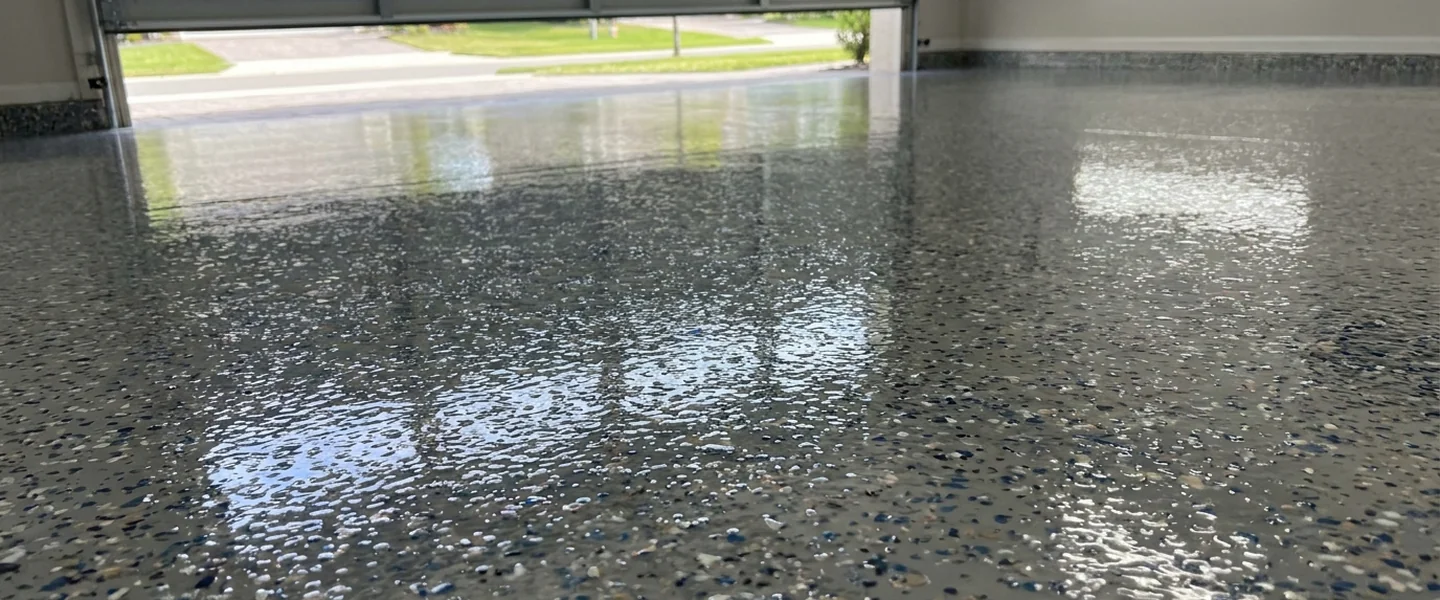
Garage Floor Epoxy Coating in Lakewood, CO
Professional epoxy and polyaspartic floor coatings for Lakewood garages, basements, and commercial spaces. Diamond grinding standard. Free on-site estimate.
Call (970) 972-0880Lakewood sits immediately west of Denver along US-6 and the 6th Avenue corridor, and its housing stock spans four distinct eras: post-war ranch homes from the 1950s and 1960s in neighborhoods like Edgemont and Green Gables, mid-century development along Wadsworth and Kipling, newer construction in Solterra and the Belmar area, and commercial development along the W Light Rail corridor. That range in construction era means we see a wide range of concrete conditions on every Lakewood project — and each condition requires calibrated preparation to produce a coating that lasts through Colorado winters.
Lakewood garages face the same freeze-thaw stress as anywhere in the Denver metro, but Lakewood's position against the foothills also means residents deal with more wind-driven road salt accumulation and some of the most intense UV exposure in the metro — south-facing garages near the Red Rocks and Green Mountain areas see significant solar loading on Colorado's high-altitude sunny days. Polyaspartic systems handle both the UV and the hot-tire stress better than standard epoxy, which is why we recommend polyaspartic topcoats on all of our Lakewood installations regardless of which base system you select.
What We Typically Find in Lakewood Garage Slabs
Lakewood's older neighborhoods — Edgemont, Morse Park, and the original Lakewood Village areas — have concrete that was poured in the 1950s–1970s. These slabs typically have significant surface carbonation, a hardened laitance layer, and decades of oil contamination from vehicles. The surface carbonation layer is the key challenge: it's a weak bond plane that prevents coating adhesion if not removed by diamond grinding. Acid etching cleans the surface but doesn't remove the carbonated layer — grinding does.
The newer Solterra community and the Belmar-adjacent developments have concrete in better condition, but many of those slabs were poured with standard residential curing compounds that need to be ground away before coating. Solterra's higher-end homes often have finished or semi-finished garage spaces that homeowners want to coat with metallic epoxy for a showroom look — the preparation standard is identical regardless of the visual system selected.
Commercial concrete in Lakewood's US-6 and Wadsworth commercial zones tends to have more complex preparation requirements — vehicle traffic, hydraulic fluid exposure, and in some cases prior coating remnants from previous tenant buildouts. We assess commercial concrete on a case-by-case basis.
Our Process for Lakewood Homes
- 1On-Site Assessment — We visit your Lakewood address, evaluate the concrete, test for moisture vapor emission, check for oil contamination and prior coatings, and give you an honest assessment before we quote.
- 2Written Quote — Itemized in writing: preparation scope, materials, labor, flake or color selection, and warranty. No phone quotes — the concrete has to be seen before an accurate price can be given.
- 3Diamond Grinding & Prep — Full-day surface preparation: diamond grinding to CSP-3 profile, crack repair with polyurea filler, edge grinding, and thorough vacuum cleaning. Oil contamination in older Lakewood slabs may require pre-grinding degreaser treatment.
- 4Coating System Application — Primer, base coat, full-broadcast flake, and polyaspartic topcoat. Metallic epoxy systems add an additional mid-coat step and require a skilled hand application. Applied on Day 2 following surface prep.
- 5Cure & Care Instructions — Light foot traffic at 24 hours; vehicle traffic at 72 hours. Written care sheet left at job completion covering maintenance, chemical restrictions, and warranty claim procedures.
Lakewood-Specific Coating Considerations
Lakewood's proximity to the foothills creates a UV environment that is noticeably more intense than east Denver. The altitude, combined with Lakewood's generally sunnier microclimate relative to the metro core, accelerates UV degradation of coatings that aren't specifically formulated for UV stability. Standard aromatic epoxies — the most common type installed by franchise crews — yellow visibly within one to two years on south or west facing Lakewood garages with any window exposure.
Our polyaspartic topcoats are aliphatic — meaning their chemistry doesn't react to UV — and we use UV-stable formulations on every Lakewood installation. Color hold under UV is one of the clearest visible differences between a properly specified floor coating system and a low-bid franchise installation after two or three Colorado summers.
Lakewood also sits in a wind corridor that funnels road salt and road grime from the 6th Avenue and US-6 express lanes westward into garage interiors. Homeowners in the neighborhoods immediately south of 6th Avenue between Wadsworth and Kipling report noticeably more road salt accumulation than comparable Denver neighborhoods. We account for this in our surface preparation assessment — salt-contaminated concrete needs to be addressed before coating, not after.
Coating Options for Lakewood Homeowners
Full-Flake Polyaspartic
UV-stable, single-day or two-day installation. Full-broadcast vinyl flake in dozens of color blends. Best for most Lakewood garages — especially those with UV exposure from south or west windows.
Metallic Epoxy Showroom
For Solterra and finished-garage spaces in Lakewood's higher-end neighborhoods. Bronze, copper, pearl, and gunmetal finishes. Every metallic floor is unique.
Basement & Interior Staining
Acid or water-based concrete staining for Lakewood basements where a natural concrete look is preferred over a coated surface. Penetrating sealers for moisture resistance.
Commercial Epoxy
Heavy-duty systems for Lakewood's commercial and light industrial spaces along Wadsworth, Kipling, and the US-6 corridor. Chemical-resistant formulations and forklift-rated systems.
What We Typically See in Lakewood Zip Codes
In the 80226 and 80227 zip codes covering the Edgemont, Morse Park, and Bear Creek neighborhoods, we consistently encounter post-war concrete with laitance buildup and oil penetration to 1–2 inches depth. These slabs benefit from aggressive grinding and, in severe oil contamination cases, an encapsulating primer rather than standard epoxy primer to prevent oil migration through the coating over time.
In the 80228 zip code covering the Green Mountain and Lakewood foothills neighborhoods, the concrete is generally newer and in better condition, but these are the homes with the highest UV exposure in Lakewood — the south-facing hill positioning combined with the altitude makes UV stability a top priority for any coating system. Solterra (80228) homes frequently want the full metallic epoxy system to match the design intent of their finished garage spaces.
Lakewood Floor Coating FAQ
Do you serve all Lakewood neighborhoods, including Solterra and Bear Creek?
Yes — we serve all Lakewood zip codes including 80214, 80215, 80226, 80227, and 80228, covering neighborhoods from Edgemont and Green Gables to Solterra and Bear Creek. Call (970) 972-0880 to schedule a free on-site estimate.
My Lakewood garage has heavy oil staining — is that a problem?
Oil contamination is addressable, not disqualifying. Deep oil saturation may require a degreaser treatment before grinding, and in severe cases an oil-encapsulating primer rather than standard epoxy primer. We identify oil contamination depth at the on-site assessment and specify the right primer for the condition. An oil-contaminated slab that's properly treated will hold a coating just as well as clean concrete.
Why does epoxy yellow in Lakewood garages specifically?
Standard epoxy uses aromatic chemistry that reacts to UV light, causing visible yellowing. Lakewood's altitude and proximity to the foothills mean higher UV intensity than lower-elevation Colorado markets. Our polyaspartic topcoat is aliphatic — it doesn't react to UV — and maintains its color indefinitely in Lakewood's UV environment. If your current floor is yellowing, that's the coating, not the concrete.
How does a Lakewood garage coating hold up in winter?
Colorado winters stress garage coatings through freeze-thaw cycling and road salt. Our systems are specified for Colorado's temperature range and use semi-rigid crack filler that flexes with thermal movement. Polyaspartic topcoats are highly resistant to road salt and calcium chloride. The prep and materials together produce a system designed to outlast Colorado winters, not fail in the first one.
Can you coat a Lakewood basement floor?
Yes — basements in Lakewood sometimes have elevated moisture vapor emission, particularly in lower-elevation neighborhoods near Bear Creek. We test for moisture before recommending any coating system for a basement. If moisture is within range, epoxy or polyaspartic basement systems work well. If it's elevated, we'll tell you what the options are before you decide to proceed.
Garage Floor Coating in Lakewood, CO
UV-stable polyaspartic systems. Diamond grinding standard. Free on-site estimate.
Call (970) 972-0880