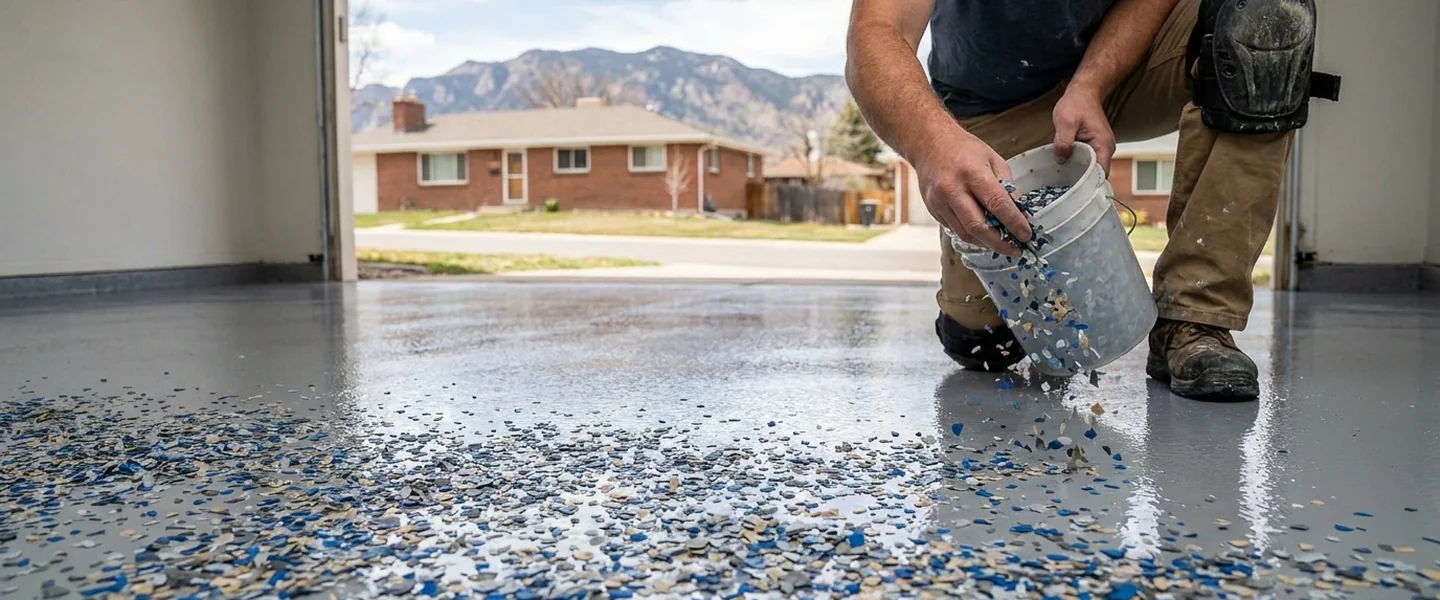
Garage Floor Epoxy Coating in Denver, CO
Professional epoxy floor coating systems engineered for Colorado's freeze-thaw cycles, road salt exposure, and hot-tire demands. Free on-site estimate across the Denver metro.
Call (970) 972-0880Garage floor epoxy coating is one of the most impactful upgrades a Denver homeowner can make — and one of the most frequently done wrong. The Denver market is full of low-bid crews that skip mechanical surface preparation, use water-based epoxy thinned with solvents, and deliver a coating that looks fine for six months and peels off the first winter. Colorado's freeze-thaw cycles are relentless: water gets under a coating installed without proper mechanical profile, freezes, expands, and separates the coating from the slab. Hot-tire pickup — when hot tires from summer driving bond to the coating surface and peel it off when the car pulls out — happens with products that don't use a hard topcoat.
Denver Floor Coating installs systems built to last: polyurea primer for deep penetration and moisture tolerance, a high-build epoxy base coat with full-broadcast vinyl flake, and a UV-stable polyaspartic topcoat that resists hot tires, road salt, chemicals, and abrasion. Every installation starts with diamond grinding — not acid wash, not light sanding — to create the mechanical profile that determines whether the coating stays down for 20 years or peels in the first winter.
What Garage Floor Epoxy Means in Denver
Denver's climate creates specific failure modes that generic epoxy floor systems don't account for. The Front Range temperature swing — sub-zero nights in January, 90°F afternoons in July, and rapid temperature changes during Denver's famous spring and fall weather — creates mechanical stress in garage slabs and the coatings applied to them. The coatings that fail in Colorado garages are typically installed without accounting for this thermal cycling.
Road salt and calcium chloride — which Denver uses heavily during winter — penetrate unsealed concrete and create a salt-contaminated surface that bonds poorly with standard coatings. Proper surface preparation that includes testing for surface contaminants and using a primer formulated for penetration through surface contamination is essential for durability in the Denver climate.
Colorado's altitude also affects coating chemistry. At Denver's 5,280 feet, some coating formulations cure differently than at sea level — slower solvent evaporation in some conditions, faster in others. Products and mixing ratios need to be calibrated for altitude. We've been installing coatings at Denver-area elevations long enough to know how our products behave at altitude.
Project Details
| Install Timeline | 2 days: Day 1 prep, Day 2 coating — most garages complete in this schedule |
|---|---|
| Cure Time | Light foot traffic 24 hours; vehicle traffic 48–72 hours after topcoat |
| Surface Prep | Diamond grinding to CSP-3 mechanical profile (standard on every job) |
| System | Polyurea primer + high-build epoxy base + full vinyl flake broadcast + polyaspartic topcoat |
| Warranty | 10-year transferable — covers peeling, delamination, hot-tire failure |
| Pricing | Quoted per job after free on-site inspection — every quote is itemized in writing |
Our Garage Floor Epoxy Installation Process
- 1On-Site Assessment — We visit your garage, measure the square footage, inspect the concrete condition, perform a moisture vapor emission test, and identify any cracks, spalls, or contamination that needs to be addressed before coating.
- 2Written Flat Quote — Based on what we see, we give you an itemized written quote covering the full scope of work. You approve it before any work starts.
- 3Day 1 — Surface Preparation — Diamond grinding to mechanical profile (CSP-3), crack and joint repair with semi-rigid polyurea filler, edge work with hand grinder, and thorough cleaning. This day is the foundation of the installation's longevity.
- 4Day 2 — Primer Application — Polyurea primer applied to the prepared surface, filling any remaining micro-porosity and providing a bonding layer that tolerates residual moisture better than standard epoxy primers.
- 5Day 2 — Base Coat & Flake — High-build epoxy base coat rolled in sections, followed immediately by full-broadcast vinyl color flake to rejection. Excess flake is swept and recovered after cure.
- 6Day 2 — Polyaspartic Topcoat — UV-stable polyaspartic topcoat applied for chemical resistance, hot-tire durability, and gloss. This layer determines the floor's long-term appearance and protection.
Materials We Use
| Primer | Polyurea moisture-tolerant primer — penetrates surface contamination better than standard epoxy primer |
|---|---|
| Base Coat | 100% solids high-build epoxy — minimum 80 mils wet film thickness |
| Color Flake | Vinyl acetate color chips, 1/4" standard, custom blend options available |
| Topcoat | Aliphatic polyaspartic — UV-stable, 90+ Shore D hardness, chemical-resistant |
| Crack Filler | Semi-rigid polyurea joint and crack filler — maintains flexibility through thermal cycling |
Common Scenarios We See in Denver Garages
Prior Coating Failure
Many Denver homeowners come to us after a low-grade epoxy coating peeled in the first or second winter. Proper removal of failed coatings and full diamond grinding before a new installation is essential — no new coating can bond over a compromised surface.
New Construction Garages
New builds in Highlands Ranch, Centennial, and Stapleton communities often have garages with bare concrete slabs ready for coating. We typically recommend waiting 90 days after slab pour for proper concrete cure before coating installation.
Oil-Stained Garage Floors
Oil contamination in Denver garages — from vehicle maintenance during long winters — requires specific surface prep that grinding alone doesn't resolve. We treat oil-contaminated areas before coating to ensure proper adhesion.
Garage-to-Gym Conversions
Denver's active lifestyle drives a lot of garage-to-home-gym conversions. A professional epoxy coating is part of the conversion — easy to clean, durable under equipment, and dramatically better-looking than bare concrete.
Why Denver Homes Need Epoxy — Not Just Any Coating
The Denver metro's 300+ days of sunshine per year means UV exposure for any coating near doors or windows. Standard epoxy yellows under UV — polyaspartic topcoats hold color indefinitely. Denver's road salt season runs from October through March, and salt-laden water tracked from the driveway into the garage attacks the concrete surface repeatedly every winter. An uncoated or improperly sealed slab absorbs this contamination year after year, accelerating deterioration. A proper epoxy system seals the surface against salt intrusion and makes cleanup as simple as a wet mop.
Colorado's active outdoor culture also means Denver garages store mountain bikes, ski and snowboard gear, kayaks, paddleboards, and camping equipment — items that get dragged across the floor constantly. An epoxy floor handles this traffic without marking. Bare concrete scuffs, marks, and generates concrete dust that coats everything stored in the space.
Warranty in Detail
Our 10-year transferable warranty covers peeling, delamination, and hot-tire bond failure — the three most common epoxy floor failures. What's covered: the coating separating from the slab in any area, blistering from below the surface, and surface lift from normal vehicle tire contact.
What's not covered: mechanical damage from sharp impacts (dropped tools, vehicle jack contact), staining from chemicals not disclosed at installation (some industrial solvents can affect polyaspartic topcoats), and damage from improper use of cleaning chemicals that degrade the topcoat surface.
The warranty is transferable to new owners at property sale — just notify us of the ownership change. Transferability adds documented value to the floor as a home improvement at resale time.
How We Quote Garage Floor Epoxy in Denver
We don't quote garage floor epoxy over the phone. Square footage matters, but it's only one variable. Concrete condition, existing crack patterns, moisture vapor emission rate, whether a prior coating needs to be removed, and access conditions in the garage all affect the scope and the price. A phone quote for a Denver garage floor epoxy job is a guess — and it's usually the wrong guess that leads to a dispute on installation day.
Our on-site estimate takes 20–30 minutes. We measure, assess, test, and give you an itemized written quote that covers the full scope. You know exactly what you're getting and what it costs before we schedule the installation. Call (970) 972-0880 to schedule your free on-site estimate.
After Your Garage Floor Is Coated
At the 24-hour mark, light foot traffic is safe. At 48–72 hours, vehicle traffic can begin. During the first 7 days while the topcoat fully cures, avoid dragging sharp objects and keep rubber mats off the surface (rubber can leave marks on a freshly cured polyaspartic surface).
Long-term maintenance is simple: sweep regularly to remove grit and debris, mop with a pH-neutral cleaner, and avoid bleach or acid-based cleaners that degrade the polyaspartic topcoat over time. A well-maintained polyaspartic surface holds its gloss for 10–15 years under normal garage use. At the 30-day mark after installation, we schedule a courtesy follow-up call to confirm the floor is performing correctly and answer any questions about care and maintenance.
Garage Floor Epoxy FAQ — Denver, CO
How long does garage floor epoxy installation take in Denver?
Most Denver-area garage floor epoxy installations take two days: Day 1 for surface preparation (diamond grinding, crack repair, cleaning) and Day 2 for the coating system (primer, base coat, flake, topcoat). Large garages or those requiring extensive crack repair may add a half-day. We'll give you the specific timeline at the estimate visit.
Why does Denver's climate matter for epoxy floors?
Denver's freeze-thaw cycles, road salt exposure, and significant temperature swings between summer and winter create failure conditions that generic epoxy floor systems aren't designed to handle. We use materials and installation methods specifically calibrated for Colorado's Front Range climate — polyurea primers that tolerate moisture, semi-rigid crack fillers that flex through thermal cycling, and UV-stable polyaspartic topcoats that don't yellow in Colorado's intense sunshine.
What's the difference between epoxy and polyaspartic?
Epoxy is the base coat — it provides adhesion, build, and the foundational protection layer. Polyaspartic is the topcoat — it provides UV stability, chemical resistance, hot-tire resistance, and durability. Our system uses both: epoxy as the body of the coating and polyaspartic as the protective surface layer. "Polyaspartic floor" and "epoxy floor" are often used interchangeably in marketing, but a proper system uses both materials in sequence.
Can you coat a garage floor that already has an old epoxy coating?
It depends on the adhesion of the existing coating. If the old coating is still firmly bonded, it can sometimes be profiled and recoated. If it's peeling or delaminating — as many Denver garage coatings do after the first few winters — it needs to be fully removed before a new system can be installed. We assess the existing coating at the estimate visit and tell you what's required before we quote the job.
Do you work in the winter in Colorado?
Yes, with conditions. Coating application requires concrete temperatures above 50°F for proper cure. In Colorado winters, this typically means we can work in heated garages year-round, and in unheated garages during the shoulder seasons (spring and fall) and warmer winter days. During our coldest months, we assess concrete temperature at the time of installation and will reschedule if conditions don't meet application requirements. We'd rather reschedule than install a coating that fails because of cold concrete.
How do I maintain an epoxy garage floor in Denver?
Sweep regularly to remove grit that can scratch the topcoat surface. Mop with a pH-neutral cleaner — avoid bleach, vinegar, or acid-based cleaners. Clean oil spills promptly (our polyaspartic topcoat resists oil but prolonged contact can stain). Don't drag rubber mats or tires across the surface for the first 30 days while the topcoat fully cures. The polyaspartic surface holds its appearance with minimal maintenance for 10–15 years of normal garage use.
Is the warranty really transferable?
Yes — the 10-year warranty transfers to new owners at property sale. Notify us of the sale and ownership change, and the warranty documentation is updated to the new owner. This is a genuine added value at resale — a documented professional floor coating installation with remaining warranty coverage is a differentiator compared to homes with bare concrete or failed DIY coatings.
What size garage do you work on?
From a single-car garage to multi-bay commercial spaces. One-car garages, two-car garages, three-car garages, and oversized garage spaces are all within scope. Larger commercial or warehouse floor projects are also available — call to discuss square footage and timeline for commercial jobs.
Garage Floor Epoxy Coating — Denver Metro
Free on-site estimate. Written flat price. 10-year transferable warranty. Same-week scheduling.
Call (970) 972-0880Related Services
What You Get in Our Quote vs. the Lowball Bid
We don't compete on the lowest sticker price — we compete on the quote that gets the job actually done. Here is what is included in every quote we write, and the cut-corners that show up in cheaper bids.
Included in our written quote
- Concrete moisture + porosity testing
- Crack and pitting repair before coating
- Full diamond-grind surface prep
- Written quote with flake/coat specs
- Cure-time schedule you can plan around
- 5-year warranty against delamination
Cut corners in the lowball bid
- Coating over uncured or wet slab
- Roller-only prep (no diamond grind)
- Lowball quotes without crack repair
- Subbed-out installation
- No moisture testing before coat
- Warranties full of fine print