Commercial Epoxy Flooring in Denver, CO
Heavy-duty commercial floor coating for Denver warehouses, auto shops, breweries, retail spaces, and industrial facilities. Built for high-traffic, chemical-exposure, and forklift environments.
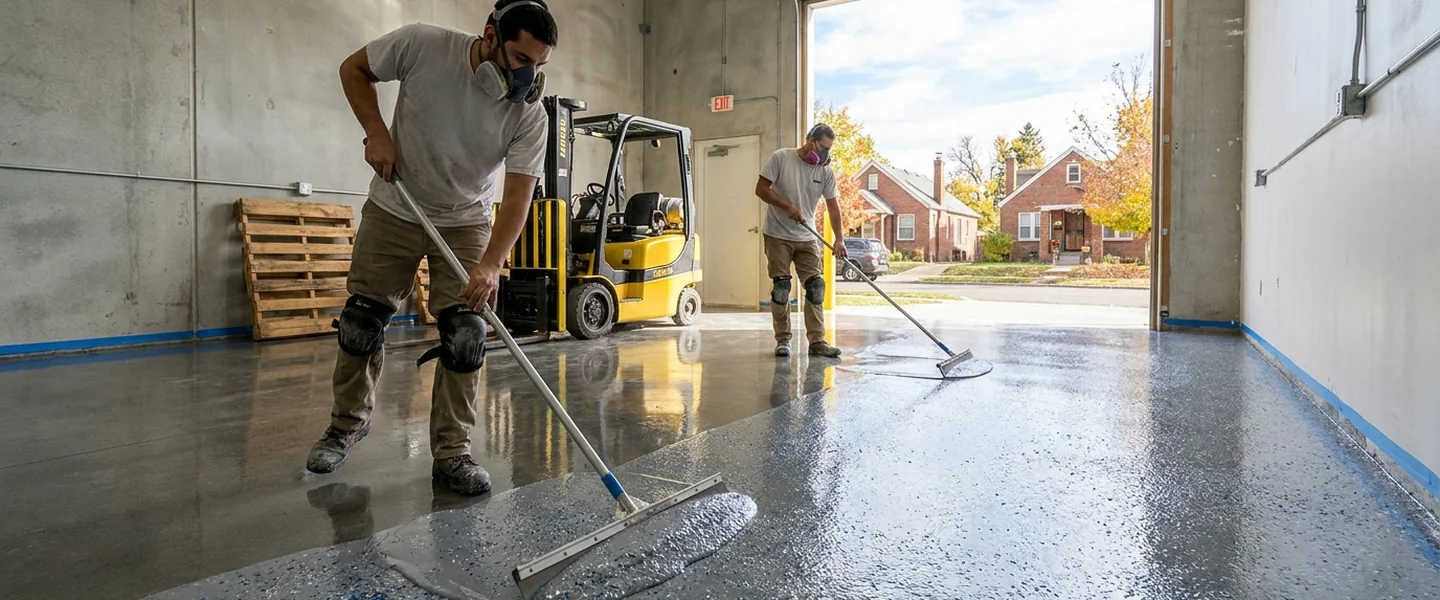
Call (970) 972-0880Commercial epoxy flooring in the Denver area demands heavier systems than residential garage coatings. Forklifts, pallet jacks, heavy equipment, chemical spills, and constant foot traffic in a warehouse or industrial facility put demands on a floor coating that a standard residential epoxy can't handle. Denver Floor Coating installs commercial-grade epoxy systems — thicker, harder, and formulated specifically for the exposure conditions of each commercial environment — across Denver's industrial corridors, Lakewood's commercial zones, Aurora's distribution facilities, and small to mid-size commercial spaces throughout the metro.
Every commercial floor installation starts with understanding the use environment before specifying the system. A brewery has different chemical exposure requirements than an auto shop. A retail showroom needs a different aesthetic profile than a machine shop floor. We select the coating system based on the actual conditions the floor will face — not a one-size-fits-all commercial epoxy specification.
Commercial Flooring Applications We Handle
- Warehouses and distribution centers — forklift-rated systems with slip-resistant aggregate in traffic lanes
- Auto shops and dealerships — chemical-resistant systems that withstand oil, brake fluid, transmission fluid, and degreaser exposure
- Craft breweries and food production — USDA-compliant, non-porous, and antimicrobial-capable systems with floor drain integration
- Retail and showroom spaces — high-gloss or decorative systems that perform in heavy foot traffic while maintaining appearance
- Fitness studios and gyms — impact-resistant, slip-resistant systems that handle dropped weights and high-volume foot traffic
- Healthcare and laboratory spaces — seamless, non-porous systems that meet cleanroom or medical-grade cleanliness requirements
- Commercial kitchens — anti-slip systems rated for water, grease, and cleaning chemical exposure
Project Details
| System Thickness | Commercial systems typically 120–250 mils (vs. 80–100 mils for residential) |
|---|---|
| Install Timeline | Varies by square footage — most commercial projects complete in 2–5 days |
| Cure & Return to Service | Light traffic 24 hours; forklift/heavy equipment 72–96 hours; full cure 7 days |
| Surface Prep | Diamond grinding, shot blasting for larger spaces, moisture vapor testing |
| Downtime Planning | We work with your operations schedule to minimize production disruption |
| Pricing | Quoted per job after free on-site inspection — every quote is itemized in writing |
Our Commercial Floor Coating Process
- 1Site Assessment & System Specification — We evaluate the facility, the chemical and mechanical exposure conditions, the square footage, the existing concrete condition, and your operational schedule requirements. The right system is specified before any quote is produced.
- 2Written Flat Quote — Itemized quote covering prep scope, materials, labor, timeline, and return-to-service schedule. Commercial quotes are specific — no "TBD" line items that change at installation.
- 3Surface Preparation — Diamond grinding or shot blasting to mechanical profile, crack and joint repair, edge work, and thorough cleaning. Commercial concrete often has more contamination history than residential slabs — we account for this in prep scope.
- 4Primer Application — Heavy-duty commercial primer with penetration depth appropriate for the exposure environment. Chemical-resistant primers for applications where solvent or acid exposure is expected.
- 5Base Coat & Build Coats — Commercial systems typically require multiple build coats to achieve the specified film thickness — often 120–250 mils versus the 80–100 mils standard in residential garage systems.
- 6Topcoat & Anti-Slip Treatment — Polyaspartic or urethane topcoat with slip-resistant aggregate added where foot traffic or wet conditions require. Traffic lane markings, safety stripes, and equipment zones added as specified.
Why Denver Commercial Floor Specifications Matter
Denver's commercial and industrial market has grown significantly along the I-70 and I-25 corridors and in suburbs like Aurora, Commerce City, and Lakewood. Facilities in these areas face Colorado-specific conditions: cold winters that stress floor coatings through thermal cycling, road salt tracked from parking lots into facility entrances, and altitude-driven differences in coating cure behavior.
Commercial floors also face the compounding effect of chemical exposure over time. An auto shop floor that sees daily oil and brake fluid exposure needs a chemical-resistant coating that a standard residential epoxy can't provide. A brewery floor exposed to cleaning acids and CO2 requires a system formulated for that specific chemical environment. We specify commercial systems based on the actual exposure — not a generic "commercial" label.
Minimizing Operational Downtime
Downtime is a real cost for commercial operations. We work with facility managers to schedule commercial floor installations around operational requirements — weekend installations, phased section installations for facilities that can't go fully offline, and fast-cure polyaspartic systems when return-to-service timing is critical.
For multi-section or phased installations, we coordinate the installation sequence with your operations team to keep the maximum functional area of the facility available throughout the project. This approach is common for auto dealerships, large warehouses, and facilities that operate 7 days a week.
How We Quote Commercial Epoxy Flooring
Commercial floor coating quotes are more complex than residential garage quotes. We assess square footage, concrete condition, chemical exposure history, load requirements, timeline sensitivity, and aesthetic requirements before specifying a system and quoting a price. The quote you receive is specific to your facility and the system we've specified for it — not a per-square-foot range that might not apply to your actual conditions.
Call (970) 972-0880 to schedule a commercial floor assessment. We'll bring the right specifications to the site visit and give you a quote that reflects your actual facility requirements.
After Your Commercial Floor Is Installed
Return-to-service timelines for commercial floor coatings depend on the system installed and the temperature at cure time. For most polyaspartic commercial systems: light foot traffic in 4–6 hours, light equipment (pallet jacks, hand trucks) at 24 hours, forklift traffic and heavy equipment at 72–96 hours, and full chemical resistance achieved at 7 days. We provide a written return-to-service schedule with every commercial installation — don't accept verbal assurances on cure timeline for a floor your operation depends on.
At 30 days post-installation, we conduct a follow-up inspection to confirm adhesion, check any areas of concern, and document floor condition for warranty purposes. This documentation matters if a warranty claim is ever filed — having a baseline record of the floor at 30 days establishes what was present at installation versus what developed later.
Ongoing maintenance for commercial epoxy floors is straightforward: sweep regularly to remove abrasive debris from forklifts and foot traffic, use pH-neutral cleaners for routine mopping, and address chemical spills promptly — particularly solvents, acids, and concentrated cleaning agents that can degrade topcoat chemistry if left to dwell. For auto shop applications, brake fluid and transmission fluid should be wiped up immediately rather than allowed to pool. For brewery floors, cleaning acid exposure should be minimized by thorough rinsing after CIP cycles.
Topcoat recoating — rather than full system replacement — is often appropriate for commercial floors that see heavy traffic. When the topcoat shows significant wear but the base coat is still adhering well, a topcoat recoat at year 8–12 restores surface protection and chemical resistance at a fraction of full system replacement cost. We assess floor condition and advise on recoat timing at the annual follow-up call.
Commercial Epoxy FAQ — Denver, CO
Can you work nights or weekends to minimize our downtime?
Yes — we schedule commercial installations around operational requirements. Night shifts, weekend installations, and phased section-by-section installations are all options we can work with. Discuss your operational constraints at the assessment and we'll propose an installation schedule that minimizes disruption.
Do you install floor safety markings and traffic lanes?
Yes — safety stripes, traffic lane markings, equipment zone outlines, and loading dock markings can be applied as part of the floor coating installation. We use durable coating-compatible materials that won't peel independently of the floor system.
What's the difference between commercial and residential epoxy systems?
Commercial systems are typically thicker (120–250 mils vs. 80–100 mils for residential), use heavier-duty chemical-resistant formulations, and require more extensive surface preparation for concrete that's been exposed to industrial contamination. The underlying principles are the same — good prep, right materials, right application — but the specifications are calibrated to the higher demands of commercial use.
How do you handle large square footage?
Large commercial floors — 5,000 to 50,000+ square feet — require coordinated crew deployment, phased installation to manage open time on large coats, and careful quality control across the full area. We have the crew capacity and project management experience for large-format commercial installations. Call to discuss your specific square footage and requirements.
Do you work with general contractors on commercial projects?
Yes — we work with general contractors, construction managers, and facility developers as subcontractors on commercial floor coating scope. We can provide certificates of insurance and work within GC-coordinated project schedules. Call (970) 972-0880 to discuss your project.
Commercial Epoxy Flooring — Denver Metro
Heavy-duty systems. Minimal downtime. Free commercial floor assessment.
Call (970) 972-0880Related Services
What You Get in Our Quote vs. the Lowball Bid
We don't compete on the lowest sticker price — we compete on the quote that gets the job actually done. Here is what is included in every quote we write, and the cut-corners that show up in cheaper bids.
Included in our written quote
- Concrete moisture + porosity testing
- Crack and pitting repair before coating
- Full diamond-grind surface prep
- Written quote with flake/coat specs
- Cure-time schedule you can plan around
- 5-year warranty against delamination
Cut corners in the lowball bid
- Coating over uncured or wet slab
- Roller-only prep (no diamond grind)
- Lowball quotes without crack repair
- Subbed-out installation
- No moisture testing before coat
- Warranties full of fine print